Monday, November 19, 2012

Monday, January 16, 2012
Movement on AIS
We have recently had some positive signs that the state is getting more serious and aggressive on aquatic invasive species (AIS) prevention. The Minnesota Department of Natural Resources has announced it will be requiring roadside AIS inspections and they will be issuing more citations for violations and requiring decontamination. In addition, the legislature has been presented with a proposal to create an invasive species research center at the University of Minnesota. This news was publically celebrated by a number of key legislators.
Until now, Minnesota’s AIS strategy has been incomplete, piecemeal and well, reliant on wishful thinking. In short, we have lacked a plan and strategy. For too long, we have hoped and many probably believed, that Minnesotans were well aware of and take appropriate voluntary protection actions so that the spread of AIS would be minimal. Those of us who observe boater behavior knew otherwise. The state reports that last year 18% of boaters stopped had violated AIS laws!
I suppose it is not productive to wonder, if these actions had been in place earlier, would Lake Minnetonka now be free of zebra mussels? But it is productive and appropriate to ask whether these new initiatives will be enough to protect Lake Minnetonka from additional AIS.
As encouraging as these developments are, we have a ways to go. The research institute must still be funded. Calling for Legacy monies is obvious, but so far, these have not been forthcoming for AIS prevention. The roadside checks and fines are appropriate, but the ‘small print’ indicates that these will be moderated so as not to unduly cause traffic congestion.
And what about protecting Lake Minnetonka? In addition to the proposed statewide efforts, we need protections on Lake Minnetonka. For 2012, the level of protection around Lake Minnetonka will be the same as it has been – and at that level, zebra mussels got in. It is time to consider access controls akin to those to be in place on Christmas Lake.
A recent Star-Tribune editorial (January 10, 2010) ends, “With a timely bipartisan push, Minnesota can bring a new sense of urgency to the invasive-species battle before it's a lost cause.” We agree, although we would argue the sense of urgency is not new, rather the sense of recognition that AIS are ruining our lakes is.
We need an AIS plan and strategy. Minnesota’s stated objective is to ‘slow the spread’ of AIS, which is meaningless in a management context. A true plan and strategy would state a measureable and actionable objective and identify the real needs. Lacking a plan with measurable objectives, we have been confusing doing something (doing anything) with doing what is needed.
Last April, I recall MN DNR Commissioner Landwehr telling the Minnesota Waters’ conference attendees, “We will never absolutely stop the spread of AIS, but if in ten years only ten more lakes have zebra mussels, I will consider that a success.” In 2011, zebra mussels were discovered in eight new lakes. We have a ways to go.
We applaud the new enthusiasm and initiatives and urge our leaders to follow through with adequate funding and priorities. We encourage our leaders to take real, strategic actions to protect our lakes from AIS, because more lakes are at risk of being invaded by more species.
Until now, Minnesota’s AIS strategy has been incomplete, piecemeal and well, reliant on wishful thinking. In short, we have lacked a plan and strategy. For too long, we have hoped and many probably believed, that Minnesotans were well aware of and take appropriate voluntary protection actions so that the spread of AIS would be minimal. Those of us who observe boater behavior knew otherwise. The state reports that last year 18% of boaters stopped had violated AIS laws!
I suppose it is not productive to wonder, if these actions had been in place earlier, would Lake Minnetonka now be free of zebra mussels? But it is productive and appropriate to ask whether these new initiatives will be enough to protect Lake Minnetonka from additional AIS.
As encouraging as these developments are, we have a ways to go. The research institute must still be funded. Calling for Legacy monies is obvious, but so far, these have not been forthcoming for AIS prevention. The roadside checks and fines are appropriate, but the ‘small print’ indicates that these will be moderated so as not to unduly cause traffic congestion.
And what about protecting Lake Minnetonka? In addition to the proposed statewide efforts, we need protections on Lake Minnetonka. For 2012, the level of protection around Lake Minnetonka will be the same as it has been – and at that level, zebra mussels got in. It is time to consider access controls akin to those to be in place on Christmas Lake.
A recent Star-Tribune editorial (January 10, 2010) ends, “With a timely bipartisan push, Minnesota can bring a new sense of urgency to the invasive-species battle before it's a lost cause.” We agree, although we would argue the sense of urgency is not new, rather the sense of recognition that AIS are ruining our lakes is.
We need an AIS plan and strategy. Minnesota’s stated objective is to ‘slow the spread’ of AIS, which is meaningless in a management context. A true plan and strategy would state a measureable and actionable objective and identify the real needs. Lacking a plan with measurable objectives, we have been confusing doing something (doing anything) with doing what is needed.
Last April, I recall MN DNR Commissioner Landwehr telling the Minnesota Waters’ conference attendees, “We will never absolutely stop the spread of AIS, but if in ten years only ten more lakes have zebra mussels, I will consider that a success.” In 2011, zebra mussels were discovered in eight new lakes. We have a ways to go.
We applaud the new enthusiasm and initiatives and urge our leaders to follow through with adequate funding and priorities. We encourage our leaders to take real, strategic actions to protect our lakes from AIS, because more lakes are at risk of being invaded by more species.
Sunday, December 18, 2011
Have the Milfoil Treatments Worked?
Yes, on several levels.
To review, the Lake Minnetonka Association in cooperation with others, initiated a bay-wide milfoil control program in 2008. This program involved three bays (Carmans, Grays and Phelps) in 2008, then Gideon and St. Albans Bays were added in 2011. The program is guided by Lake Vegetation Management Plans, which are approved by the MN Department of Natural Resources. The program has several objectives, including controlling milfoil to specified levels, protecting native plants and minimizing lakeshore clean up of milfoil fragments.
This program has benefitted from the participation of the US Army Corps of Engineers who have provided expertise, detailed monitoring and evaluation. Most of the results I report here are from their technical reports.
Have the treatments controlled milfoil? Yes. We have evaluated the ‘frequency of occurrence,’ which means the percentage of sampling points with milfoil. Prior to the treatments, milfoil covered over 60% of each bay. Following the treatments, milfoil covered has been substantially reduced – in some cases to zero. The results, however, have varied. In the first year, 2008, the herbicide concentration was too low or had dissipated too quickly and the treatment effects were poor. Since then, we have modified the herbicide concentrations and timing so that this year (2011) we have met the program’s objectives of less than 20% milfoil coverage in the treated bays.
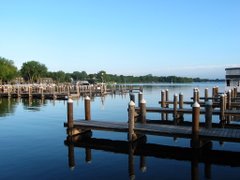
Another indicator of milfoil control is the overall abundance or matting amounts, which have visibly improved. No objective measures of this aspect have been included in the program; however, there are other positive indicators worth noting. For example, lakeshore owners on several of the bays have noted an increase in water-related activities, such as skiing and tubing, where these were not even possible previously. In addition, I have received hundreds of comments regarding the lack of matting among all the bays. Many will recall that major portions of Grays and Phelps Bays had previously been unavailable for any kind of boating. The photo shows Gray Bay in August of this year, the third season following the last treatment, with no matted milfoil evident.
Have the treatments protected native plants? Yes. The plan called for evaluating the number of native plant (measured as average number of species per sample point). In every case, except Grays Bay in 2009, this average remained the same or increased following the treatments, again meeting the plan’s objectives. This number decreased in Grays Bay in 2009; however, it is not clear this decrease was related to the treatments as native plants decreased in untreated bays that year too.
Our members have consistently reported substantially less shoreline clean up in these bays, sometimes no clean up at all. The lakeshore residents have contributed nearly a half million dollars to support this program and there have been requests to expand it to additional bays.
Is this program a silver bullet? No. This program is clearly effective and has met the objectives of the project. However, there are challenges, including the need for (and aptness for) consistent public funding. To-date, private, voluntary contributions have funded 60% of this project, which benefits a public resource. The treated bays are now useable by everyone.
Is the herbicide program safe? Yes. The herbicide products are allowed for use by the US Environmental Protection Agency and permitted for use by the MN DNR. We are aware of no objective or authoritative evidence or reports of any ill effects resulting from this project.
Is the project cost-effective? Yes. We have now narrowed to a reliable treatment program that costs about $500 per acre and is effective for two years (perhaps more). This is about $250 per acre per year, which compares to about $300 to $350 per acre per year for the harvesting program.
So, what next? We think this is a viable, valuable program worthy of continuation and expansion.
Thinking ahead, it is technically feasible to treat the entire lake! An entire lake treatment is estimated to cost less than $3,000,000. Lacking the re-introduction of milfoil from adjacent bays, I would expect a whole-lake treatment would last at least three and up to five years, representing a cost of about $100 to $170 per acre per year. While perhaps not ready for formal consideration, we are encouraged that this scale of treatment is possible.
We thank all the supporters of this treatment program and have been encouraged by the positive results. We are looking forward to ridding more bays of milfoil problems in the future.
To review, the Lake Minnetonka Association in cooperation with others, initiated a bay-wide milfoil control program in 2008. This program involved three bays (Carmans, Grays and Phelps) in 2008, then Gideon and St. Albans Bays were added in 2011. The program is guided by Lake Vegetation Management Plans, which are approved by the MN Department of Natural Resources. The program has several objectives, including controlling milfoil to specified levels, protecting native plants and minimizing lakeshore clean up of milfoil fragments.
This program has benefitted from the participation of the US Army Corps of Engineers who have provided expertise, detailed monitoring and evaluation. Most of the results I report here are from their technical reports.
Have the treatments controlled milfoil? Yes. We have evaluated the ‘frequency of occurrence,’ which means the percentage of sampling points with milfoil. Prior to the treatments, milfoil covered over 60% of each bay. Following the treatments, milfoil covered has been substantially reduced – in some cases to zero. The results, however, have varied. In the first year, 2008, the herbicide concentration was too low or had dissipated too quickly and the treatment effects were poor. Since then, we have modified the herbicide concentrations and timing so that this year (2011) we have met the program’s objectives of less than 20% milfoil coverage in the treated bays.
Another indicator of milfoil control is the overall abundance or matting amounts, which have visibly improved. No objective measures of this aspect have been included in the program; however, there are other positive indicators worth noting. For example, lakeshore owners on several of the bays have noted an increase in water-related activities, such as skiing and tubing, where these were not even possible previously. In addition, I have received hundreds of comments regarding the lack of matting among all the bays. Many will recall that major portions of Grays and Phelps Bays had previously been unavailable for any kind of boating. The photo shows Gray Bay in August of this year, the third season following the last treatment, with no matted milfoil evident.
Have the treatments protected native plants? Yes. The plan called for evaluating the number of native plant (measured as average number of species per sample point). In every case, except Grays Bay in 2009, this average remained the same or increased following the treatments, again meeting the plan’s objectives. This number decreased in Grays Bay in 2009; however, it is not clear this decrease was related to the treatments as native plants decreased in untreated bays that year too.
Our members have consistently reported substantially less shoreline clean up in these bays, sometimes no clean up at all. The lakeshore residents have contributed nearly a half million dollars to support this program and there have been requests to expand it to additional bays.
Is this program a silver bullet? No. This program is clearly effective and has met the objectives of the project. However, there are challenges, including the need for (and aptness for) consistent public funding. To-date, private, voluntary contributions have funded 60% of this project, which benefits a public resource. The treated bays are now useable by everyone.
Is the herbicide program safe? Yes. The herbicide products are allowed for use by the US Environmental Protection Agency and permitted for use by the MN DNR. We are aware of no objective or authoritative evidence or reports of any ill effects resulting from this project.
Is the project cost-effective? Yes. We have now narrowed to a reliable treatment program that costs about $500 per acre and is effective for two years (perhaps more). This is about $250 per acre per year, which compares to about $300 to $350 per acre per year for the harvesting program.
So, what next? We think this is a viable, valuable program worthy of continuation and expansion.
Thinking ahead, it is technically feasible to treat the entire lake! An entire lake treatment is estimated to cost less than $3,000,000. Lacking the re-introduction of milfoil from adjacent bays, I would expect a whole-lake treatment would last at least three and up to five years, representing a cost of about $100 to $170 per acre per year. While perhaps not ready for formal consideration, we are encouraged that this scale of treatment is possible.
We thank all the supporters of this treatment program and have been encouraged by the positive results. We are looking forward to ridding more bays of milfoil problems in the future.
Tuesday, November 22, 2011
Decontamination, gates and fees, oh my!
There is now a gate installed at the Christmas Lake access. Carver County Parks has approved a plan and recommended funding for mandatory inspections for all boats entering Lake Minnewashta. This plan calls for turning boats away or requiring them to be decontaminated should they fail the inspection. Other area lake associations, such as Lotus Lake, Fish Lake, Medicine Lake, are arguing for similar protections.
Too much? No. Not if we are serious about protecting our lakes.
Unfortunately (for Lake Minnetonka), a zebra mussel infestation in Lake Minnetonka seems to have been a wake up call for others. For the sake of other lakes, we sincerely hope it is not too late. For the sake of Lake Minnetonka, let’s pay attention because we remain exposed to quagga mussel, spiny waterflea, hydrilla, etc.
Why is this happening? Simply, the state’s rules and authorities are not adequate and nearby lake association are rightfully concerned their lake will be next. The state bureaucracy is not as nimble as aquatic invasive species (AIS) and therefore the state response has been too slow. As well, AIS pose a huge challenge on many levels and there are competing and conflicting interests. In addition, the state’s AIS protection system has evolved piecemeal and lawmakers have approached the AIS crisis too timidly. We must now either play catch up or bear the consequences.
The Department of Natural Resources (DNR) is encouraging more efforts from local partners. However, they want consistency throughout the state, which is reasonable. Unfortunately, guidelines for local authorities that could provide this consistency are not at hand. This is creating great frustration. Encouraging local initiatives and partnerships on one hand, yet not allowing them to become unshackled from the inadequate protective state overlay on the other hand is a formula for frustration. It is also a formula for failure.
In a newspaper article, a DNR official is quoted as saying, “the DNR is studying whether it can delegate inspection authority to cities, counties or watershed districts, and is working on a "package" of changes that will be announced next spring.” If we wait for this, we will have lost another year. Again, more frustration.
Underlying all of this is the inability to reconcile the state’s long-standing tradition of allowing open access to lakes with the ability of AIS to exploit this open access. This must be confronted and reconciled if we are to be serious about protecting lakes. The Lake Minnetonka Association believes Lake Minnetonka and all Minnesota lakes are public resources that should be available for all to use and enjoy. We also believe that aggressive protection measures, such as those mentioned above, can be implemented in an equitable manner to better protect the lake without unreasonably affecting public access. In the meantime, we remain exposed.
We sometimes hear that the state constitution prohibits this kind of aggressive protection. I have asked both of my state legislators to provide an assessment of this question so we are all starting on the same page, but as of yet no answer. Until we learn otherwise, I think we should proceed in a manner that is more protective of our lakes. The Minnehaha Creek Watershed District is proposing to amend its management plan along these lines. The Lake Minnetonka Association supports this.
What next? We applaud these local initiatives and encourage their implementation. The Lake Minnetonka Association urges the local agencies responsible for protecting Lake Minnetonka to be similarly bold. Lacking this, Lake Minnetonka remains exposed to new and more AIS.
Too much? No. Not if we are serious about protecting our lakes.
Unfortunately (for Lake Minnetonka), a zebra mussel infestation in Lake Minnetonka seems to have been a wake up call for others. For the sake of other lakes, we sincerely hope it is not too late. For the sake of Lake Minnetonka, let’s pay attention because we remain exposed to quagga mussel, spiny waterflea, hydrilla, etc.
Why is this happening? Simply, the state’s rules and authorities are not adequate and nearby lake association are rightfully concerned their lake will be next. The state bureaucracy is not as nimble as aquatic invasive species (AIS) and therefore the state response has been too slow. As well, AIS pose a huge challenge on many levels and there are competing and conflicting interests. In addition, the state’s AIS protection system has evolved piecemeal and lawmakers have approached the AIS crisis too timidly. We must now either play catch up or bear the consequences.
The Department of Natural Resources (DNR) is encouraging more efforts from local partners. However, they want consistency throughout the state, which is reasonable. Unfortunately, guidelines for local authorities that could provide this consistency are not at hand. This is creating great frustration. Encouraging local initiatives and partnerships on one hand, yet not allowing them to become unshackled from the inadequate protective state overlay on the other hand is a formula for frustration. It is also a formula for failure.
In a newspaper article, a DNR official is quoted as saying, “the DNR is studying whether it can delegate inspection authority to cities, counties or watershed districts, and is working on a "package" of changes that will be announced next spring.” If we wait for this, we will have lost another year. Again, more frustration.
Underlying all of this is the inability to reconcile the state’s long-standing tradition of allowing open access to lakes with the ability of AIS to exploit this open access. This must be confronted and reconciled if we are to be serious about protecting lakes. The Lake Minnetonka Association believes Lake Minnetonka and all Minnesota lakes are public resources that should be available for all to use and enjoy. We also believe that aggressive protection measures, such as those mentioned above, can be implemented in an equitable manner to better protect the lake without unreasonably affecting public access. In the meantime, we remain exposed.
We sometimes hear that the state constitution prohibits this kind of aggressive protection. I have asked both of my state legislators to provide an assessment of this question so we are all starting on the same page, but as of yet no answer. Until we learn otherwise, I think we should proceed in a manner that is more protective of our lakes. The Minnehaha Creek Watershed District is proposing to amend its management plan along these lines. The Lake Minnetonka Association supports this.
What next? We applaud these local initiatives and encourage their implementation. The Lake Minnetonka Association urges the local agencies responsible for protecting Lake Minnetonka to be similarly bold. Lacking this, Lake Minnetonka remains exposed to new and more AIS.
Monday, October 17, 2011
Time to Downsize Milfoil Harvesting
The Lake Minnetonka Conservation District (LMCD) is contemplating replacing a damaged harvester (the LMCD’s harvester fleet totals three harvesters). The Lake Minnetonka Association, representing the interests of our members, believes replacing the third harvester is ill advised and asks the LMCD to not replace the harvester.
Over the past 12 years in this job, complaints from our members about the harvesting program have outnumbered all other concerns combined. In addition, 93% of those involved in the five bay milfoil control project prefer the herbicide program over the harvesting program. According to one commenter, “No comparison. Harvesting was a waste of money. The chemical treatment is superior in every way. St. Albans, is in all practical aspects, milfoil free.”
The Lake Minnetonka Association believes the harvesting program should be downsized because the need is diminished and other less costly, more effective options are available.
Harvesting had its day. Initiated in 1989, harvesting was the most feasible option for controlling milfoil impacts. But at its best, harvesting has limitations. For example, the harvesting operation commences in mid- to late-June and ends in mid-August. However, the boating season peaks around the Fourth of July, then declines – this offset is problematic because many areas do not receive relief until too late in the season. In addition, the harvesters generate milfoil fragments, which wash to shore and become a maintenance headache for lakeshore owners (we know milfoil fragments are generated in other ways, but the harvesters add significantly to this).
The need for the harvesters has diminished substantially. The five bays involved in the bay-wide herbicide treatments were selected because they were the worst milfoil bays. As the harvesters do not now work in these areas, there is substantially less milfoil remaining to be harvested in the lake. The total treated area in the five bays is over 600 acres, compared to the typical harvesting totals of 300 to 350 acres.
Less costly, more effective options are available. For example, contact herbicides (different from those being used in the five bay program, but the same as are being used by hundreds of lakeshore owners under permit from the MN DNR) would cost about $250 per acre (harvesting is about $300 per acre, excluding depreciation) and have these advantages: a) they can be applied early in the season and last the entire season (in June, before milfoil surfaces), b) they are applied by professional, licensed commercial applicators, c) the program is flexible and scalable – if the need is lower, the costs are lower and d) they can be targeted to the precise areas in the lake to facilitate navigation. Has contracting been explored?
Lake Minnetonka also has another invasive plant, Flowering rush, which can be spread by harvesters. There is no plan in place to control Flowering rush, indeed there is not even a monitoring program in place. We must get serious about managing these invasive plants. Lake Minnetonka lacks a comprehensive management plan for milfoil, Flowering rush and other nuisance plants.
Harvesting in some form probably has a place on Lake Minnetonka. However, milfoil is now being controlled in many of the areas previously requiring harvesting, so the need is greatly diminished. Until Lake Minnetonka has a comprehensive management plan for invasive plants, replacing the harvester is premature and ill advised.
The LMCD’s role in milfoil management has evolved incidentally to their original purchase and operation of the harvesters 23 years ago. Now, we question the LMCD’s ability to address the challenges of additional invasive plants as they lack staff expertise and sufficient financial resources. We have supported an increased role for the Minnehaha Creek Watershed District (MCWD) and we hope they rise to this need.
The members of the Lake Minnetonka Association do not support the continuation of the harvesting program in it current form and we do support the comprehensive and aggressive management of milfoil and other invasive plants consistent with sound environmental science and management.
We ask the communities around Lake Minnetonka to get together and provide direction to the LMCD and the MCWD to coordinate the most effective management program for Lake Minnetonka.
Over the past 12 years in this job, complaints from our members about the harvesting program have outnumbered all other concerns combined. In addition, 93% of those involved in the five bay milfoil control project prefer the herbicide program over the harvesting program. According to one commenter, “No comparison. Harvesting was a waste of money. The chemical treatment is superior in every way. St. Albans, is in all practical aspects, milfoil free.”
The Lake Minnetonka Association believes the harvesting program should be downsized because the need is diminished and other less costly, more effective options are available.
Harvesting had its day. Initiated in 1989, harvesting was the most feasible option for controlling milfoil impacts. But at its best, harvesting has limitations. For example, the harvesting operation commences in mid- to late-June and ends in mid-August. However, the boating season peaks around the Fourth of July, then declines – this offset is problematic because many areas do not receive relief until too late in the season. In addition, the harvesters generate milfoil fragments, which wash to shore and become a maintenance headache for lakeshore owners (we know milfoil fragments are generated in other ways, but the harvesters add significantly to this).
The need for the harvesters has diminished substantially. The five bays involved in the bay-wide herbicide treatments were selected because they were the worst milfoil bays. As the harvesters do not now work in these areas, there is substantially less milfoil remaining to be harvested in the lake. The total treated area in the five bays is over 600 acres, compared to the typical harvesting totals of 300 to 350 acres.
Less costly, more effective options are available. For example, contact herbicides (different from those being used in the five bay program, but the same as are being used by hundreds of lakeshore owners under permit from the MN DNR) would cost about $250 per acre (harvesting is about $300 per acre, excluding depreciation) and have these advantages: a) they can be applied early in the season and last the entire season (in June, before milfoil surfaces), b) they are applied by professional, licensed commercial applicators, c) the program is flexible and scalable – if the need is lower, the costs are lower and d) they can be targeted to the precise areas in the lake to facilitate navigation. Has contracting been explored?
Lake Minnetonka also has another invasive plant, Flowering rush, which can be spread by harvesters. There is no plan in place to control Flowering rush, indeed there is not even a monitoring program in place. We must get serious about managing these invasive plants. Lake Minnetonka lacks a comprehensive management plan for milfoil, Flowering rush and other nuisance plants.
Harvesting in some form probably has a place on Lake Minnetonka. However, milfoil is now being controlled in many of the areas previously requiring harvesting, so the need is greatly diminished. Until Lake Minnetonka has a comprehensive management plan for invasive plants, replacing the harvester is premature and ill advised.
The LMCD’s role in milfoil management has evolved incidentally to their original purchase and operation of the harvesters 23 years ago. Now, we question the LMCD’s ability to address the challenges of additional invasive plants as they lack staff expertise and sufficient financial resources. We have supported an increased role for the Minnehaha Creek Watershed District (MCWD) and we hope they rise to this need.
The members of the Lake Minnetonka Association do not support the continuation of the harvesting program in it current form and we do support the comprehensive and aggressive management of milfoil and other invasive plants consistent with sound environmental science and management.
We ask the communities around Lake Minnetonka to get together and provide direction to the LMCD and the MCWD to coordinate the most effective management program for Lake Minnetonka.
Sunday, September 18, 2011
Our Lake
Lakeshore owners have a strong affinity for and love of the lake where they live. This often translates into advocacy and action for preserving, protecting and improving the lake environment – a good thing. Unfortunately, this may also viewed as an indication that lakeshore owners really think it is ‘their’ lake. Or even worse, many think lakeshore owners want and expect ‘their’ lake to become their ‘private’ lake.
I say ‘their lake’ because most lakeshore owners say this, not in the sense they actually own it, rather in the sense that they take ownership in the welfare of the lake.
The position of the Lake Minnetonka Association is that Lake Minnetonka is a public resource for all to enjoy. Lake Minnetonka, as well as many lakes in Minnesota, benefit from lakeshore owners’ sense of ownership because lakeshore owners make significant investments in protecting and managing ‘their’ lakes.
Lakeshore owners welcome others’ use and enjoyment of Lake Minnetonka, but they also expect the same high level of caring and stewardship from visitors as lakeshore owners themselves.
Unfortunately, fingers often point both ways. Lake visitors point to shoreland modification, excessive weed and aquatic plant removal and large docks. Lakeshore owners point to excessive noise and speed, introduction of exotic species and sometimes rude or obnoxious behavior. Certainly, improvements can be made on both sides, but let us not forget Lake Minnetonka belongs to us all and its care ought to be borne by us all.
The Lake Minnetonka Association, on behalf of lakeshore owners, has been an unapologetic advocate for the highest level of protection and management for Lake Minnetonka. We believe aquatic invasive species (AIS) have harmed the lake and additional AIS will add to the damage. It is a reality that when AIS are introduced into a lake, it is there forever. From lakeshore owners’ perspective, AIS are brought to the lake from a visitor who can come and go, but the impacts are seen and experienced every day by lakeshore residents. From a lake users’ perspective, suggestions to control or restrict their access to minimize the threat of an AIS introduction is seen as a way to keep them out. While neither view is totally accurate, these opposing views work to keep us from addressing the underlying problems.
We must all work to see the others’ perspectives, understand the damage AIS is doing to our lakes and work to solve this huge challenge. Unfortunately, AIS exploit the way we move from lake-to-lake, and visitors move between lakes much more then lakeshore residents. So, the movement must be addressed to materially address the concern of AIS.
The better we understand and appreciate everybody’s concern for and love of this lake, and the more effort we put into finding common ground, the better, more lasting solutions will be forthcoming.
Let us (all of us) start by referring to Lake Minnetonka is ‘our’ lake – as it belongs to all of us. Then, let us think of solutions that involve all of us.
I say ‘their lake’ because most lakeshore owners say this, not in the sense they actually own it, rather in the sense that they take ownership in the welfare of the lake.
The position of the Lake Minnetonka Association is that Lake Minnetonka is a public resource for all to enjoy. Lake Minnetonka, as well as many lakes in Minnesota, benefit from lakeshore owners’ sense of ownership because lakeshore owners make significant investments in protecting and managing ‘their’ lakes.
Lakeshore owners welcome others’ use and enjoyment of Lake Minnetonka, but they also expect the same high level of caring and stewardship from visitors as lakeshore owners themselves.
Unfortunately, fingers often point both ways. Lake visitors point to shoreland modification, excessive weed and aquatic plant removal and large docks. Lakeshore owners point to excessive noise and speed, introduction of exotic species and sometimes rude or obnoxious behavior. Certainly, improvements can be made on both sides, but let us not forget Lake Minnetonka belongs to us all and its care ought to be borne by us all.
The Lake Minnetonka Association, on behalf of lakeshore owners, has been an unapologetic advocate for the highest level of protection and management for Lake Minnetonka. We believe aquatic invasive species (AIS) have harmed the lake and additional AIS will add to the damage. It is a reality that when AIS are introduced into a lake, it is there forever. From lakeshore owners’ perspective, AIS are brought to the lake from a visitor who can come and go, but the impacts are seen and experienced every day by lakeshore residents. From a lake users’ perspective, suggestions to control or restrict their access to minimize the threat of an AIS introduction is seen as a way to keep them out. While neither view is totally accurate, these opposing views work to keep us from addressing the underlying problems.
We must all work to see the others’ perspectives, understand the damage AIS is doing to our lakes and work to solve this huge challenge. Unfortunately, AIS exploit the way we move from lake-to-lake, and visitors move between lakes much more then lakeshore residents. So, the movement must be addressed to materially address the concern of AIS.
The better we understand and appreciate everybody’s concern for and love of this lake, and the more effort we put into finding common ground, the better, more lasting solutions will be forthcoming.
Let us (all of us) start by referring to Lake Minnetonka is ‘our’ lake – as it belongs to all of us. Then, let us think of solutions that involve all of us.
Friday, August 19, 2011
Community Clean-Up for Water Quality
Like many of you, I’ve read Dick Osgood’s excellent postings on the problems facing Lake Minnetonka. Invasive species like milfoil choke the lake, and zebra mussels have been introduced. The options for solving the problem of invasives are complex, confusing, expensive and highly regulated. In addition to the invasive species that trouble Lake Minnetonka’s waters is the water that runs from the streets, parking lots and rooftops into the lake. Runoff carries pollutants that feed algae, turning areas of the lake green and smelly in the summer. Among the areas affected are Halsteds Bay, Stubbs Bay, West Arm and Jennings Bay on Lake Minnetonka. Fortunately, every one of us can play a role in preventing this kind of pollution from reaching the lake.
Loose soil, leaves, grass clippings and other organic materials in our storm drains play a role in why Lake Minnetonka turns green with algae. By sweeping regularly, most cities and towns do an admirable job of keeping their streets clean. But city governments can’t do it alone.
The Freshwater Society and our partner, the Friends of the Minnesota Valley, offer a program that helps you get involved in protecting healthy waters, Community Clean-Ups for Water Quality. Locally-led groups of volunteers, rake, sweep, bag and remove loose dirt and leaves blocking sewer grates on city streets, and compost the material to prevent pollutants such as phosphorus from entering the lake.
Depending on the mix of materials, for every five bags (100 pounds) of soil, leaves and other organic debris you collect, your lake association, community group, scout troop or church group can prevent up to a pound of phosphorus from entering your local lake or river. Each pound of phosphorus can cause the growth of up to 500 pounds of algae, and every little bit helps. This fall, the Freshwater Society will be working with groups throughout the Minnehaha Creek Watershed District to sponsor Community Clean-ups for Water Quality.
The Freshwater Society is looking for neighborhood groups, churches, Scout troops and other community organizations in the Lake Minnetonka area who are interested in organizing a Community Clean-Up for Water Quality this fall. Clean-Ups typically happen in late October, after the leaves fall and before the snows begin. It’s a great community service project, simple and effective. Get involved and learn how you can be part of keeping Lake Minnetonka healthy and clean.
We have assembled a toolkit to help you implement a Community Clean-Up for Water Quality in your area. For more information on Community Cleanups for Water Quality, or to download the Toolkit, visit our website- http://freshwater.org/index.php/projects/community-cleanups-for-water-quality
For more information, or to set up a cleanup in your neighborhood, contact:
Peggy Knapp
pknapp@freshwater.org
Loose soil, leaves, grass clippings and other organic materials in our storm drains play a role in why Lake Minnetonka turns green with algae. By sweeping regularly, most cities and towns do an admirable job of keeping their streets clean. But city governments can’t do it alone.
The Freshwater Society and our partner, the Friends of the Minnesota Valley, offer a program that helps you get involved in protecting healthy waters, Community Clean-Ups for Water Quality. Locally-led groups of volunteers, rake, sweep, bag and remove loose dirt and leaves blocking sewer grates on city streets, and compost the material to prevent pollutants such as phosphorus from entering the lake.
Depending on the mix of materials, for every five bags (100 pounds) of soil, leaves and other organic debris you collect, your lake association, community group, scout troop or church group can prevent up to a pound of phosphorus from entering your local lake or river. Each pound of phosphorus can cause the growth of up to 500 pounds of algae, and every little bit helps. This fall, the Freshwater Society will be working with groups throughout the Minnehaha Creek Watershed District to sponsor Community Clean-ups for Water Quality.
The Freshwater Society is looking for neighborhood groups, churches, Scout troops and other community organizations in the Lake Minnetonka area who are interested in organizing a Community Clean-Up for Water Quality this fall. Clean-Ups typically happen in late October, after the leaves fall and before the snows begin. It’s a great community service project, simple and effective. Get involved and learn how you can be part of keeping Lake Minnetonka healthy and clean.
We have assembled a toolkit to help you implement a Community Clean-Up for Water Quality in your area. For more information on Community Cleanups for Water Quality, or to download the Toolkit, visit our website- http://freshwater.org/index.php/projects/community-cleanups-for-water-quality
For more information, or to set up a cleanup in your neighborhood, contact:
Peggy Knapp
pknapp@freshwater.org
Subscribe to:
Posts (Atom)